 SMILE SPORTS
Every youth coach has seen it happen. You’re on the sidelines, the game is moving fast, and suddenly there is a loud collision. A player drops to the floor, holding their face. When they pull their hand away, there is blood, and a white fragment is left sitting on the hardwood.
Another broken tooth.
At Smile Sports, we see the joy that athletic camps bring to local families, but we also see the harsh reality of sports injuries. While parents spend hundreds of dollars on elite sneakers and training gear, the single most important piece of safety equipment is often completely forgotten.
Here is a raw look at the numbers behind youth dental trauma, the massive financial strain it places on families, and the exact steps you need to take if your child breaks a tooth on the court.
The Staggering Numbers Behind the Game
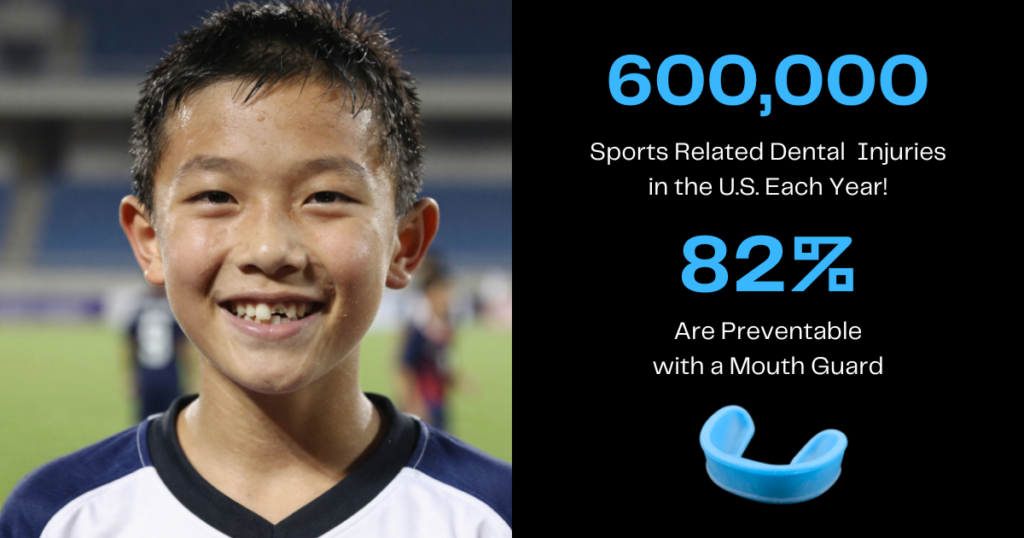
Dental injuries are not rare accidents. They are an ongoing public health crisis in youth sports. Every single year in the United States, an estimated 600,000 dental injuries occur due to sports and recreational activities.
When you dive into the data, the picture gets even more alarming:
- Fractures lead the pack: Exact tooth fractures—meaning a chipped or cleanly broken tooth—account for 50% of all sports dental trauma.
- Millions of teeth lost: The National Youth Sports Safety Foundation estimates that between 3 to 5 million teeth are completely knocked out on American athletic fields every single year.
- The highest-risk zone: Children between the ages of 7 and 17 face the absolute highest risk. Statistically, 1 in 5 youth athletes will sustain a direct injury to their mouth before graduating high school.
The $20 Shield vs. The $20,000 Medical Bill
The economic gap between different neighborhoods changes how families recover from these injuries. In affluent suburbs, a chipped tooth is a stressful weekend trip to a private dentist. In underfunded urban areas and North Side Chicago R3 zones, a broken tooth can become a permanent health disaster because families simply cannot afford the lifetime treatment costs.
Collectively, American families spend nearly $500 million annually repairing teeth broken on the field.
If a child has a permanent adult tooth completely knocked out, the immediate emergency room visit is just the beginning. Over that child’s lifetime, the cost of nerve treatments, temporary flippers, bone grafts, and eventual dental implants routinely climbs between $10,000 and $20,000 for a single tooth.
The 82% Avoidable Truth
Here is the piece of data that should make every coach and parent stop in their tracks: according to the American Dental Association, 82% of all sports-related dental injuries are completely preventable by simply wearing a properly fitted mouthguard.
That means out of the 600,000 kids who suffer dental trauma this year, nearly 500,000 of those injuries could have been entirely avoided. An athlete competing without oral protection is 60 times more likely to suffer severe, permanent damage to their smile.
Emergency Blueprint: What to Do If Your Kid Breaks a Tooth
Accidents happen in a split second. If your child chips or knocks out a tooth during a game, your fast response over the next 60 minutes determines whether that tooth can be saved. Save this exact blueprint on your phone:
Scenario A: The Tooth is Chipped or Fractured
- Find the Fragment: Search the gym floor immediately for the broken piece of tooth. Dentists can frequently bond the original fragment back onto the tooth.
- Clean the Mouth: Have your child rinse gently with warm water to clean out any dirt or blood.
- Apply Cold: Place a cold compress or ice pack against the outside of their lip or cheek to stop swelling and ease the pain.
- Call the Clinic: Contact an emergency dental provider immediately. Prompt bonding protects the exposed inner nerve from infection.
Scenario B: The Tooth is Completely Knocked Out (Adult Teeth Only)
- Handle with Care: Find the tooth, but only touch the top crown part. Never touch the sensitive root or strip away any attached tissue fragments.
- Rinse Gently: If the tooth is dirty, rinse it very gently with milk or clean water for a few seconds. Do not scrub it or dry it with a towel.
- Try to Re-Implant: If possible, immediately slide the tooth back into its socket in the child’s mouth and have them bite down gently on a piece of gauze to hold it.
- Keep it Alive: If it won’t go back in, keep the tooth wet. Drop it into a small cup of cold milk or have the child spit into a cup and submerge the tooth in their own saliva. Never store a knocked-out tooth in regular tap water, as it kills the root cells.
- The 60-Minute Window: Get to an emergency dentist or hospital immediately. If a dentist can treat the child within one hour of the accident, the chances of successfully saving the permanent tooth skyrocket.
The Smile Sports Commitment
At Smile Sports, we don’t believe a family’s zip code or financial status should dictate a child’s safety. Because public school and municipal park budgets do not provide personal safety equipment, youth in underfunded neighborhoods are left carrying the highest risk of permanent dental trauma.
Through our plug-and-play “Camp within a Camp” holiday programs, we are actively solving this problem. By uniting corporate hygiene manufacturers with local volunteer clinics—like Webster Dental Care—we ensure that every single child leaves our sports clinics with a free, premium mouthguard and the exact safety education they need to protect their smiles for life.
We are making the court a safer place, one pop-up clinic at a time.